

The County Government of Uasin Gishu, under the leadership of Governor Jonathan Bii, continues to advance sustainable agricultural transformation and environmental conservation as part of its commitment to food security, climate resilience, and economic empowerment of farmers.
The County Executive Committee Member (CECM) for Agriculture, Dr. Sam Kotut, reiterated the need to promote sustainable agricultural practices that support wetland conservation without interfering with food security, in line with the Governor’s vision of balancing agricultural productivity with environmental stewardship.

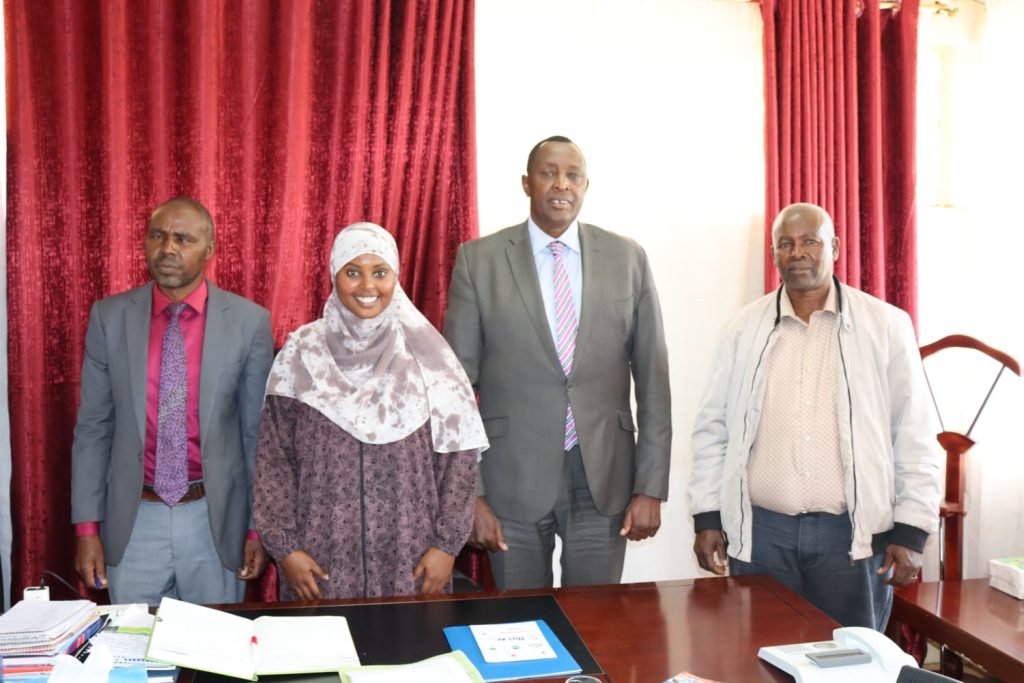
Dr. Kotut made the remarks on Thursday during a courtesy visit by representative of the International Crane Foundation (ICF), Ms. Khadija Ibrahim.
The meeting brought together the County Department of Agriculture led by CECM and the Director, to strengthen collaboration on sustainable agriculture and conservation initiatives.
Discussions highlighted Uasin Gishu County’s strategic role in biodiversity conservation, with findings from the 2023 National Crane Census indicating that the county hosts approximately 2,227 Grey Crowned Cranes, representing about 26 per cent of Kenya’s total crane population. This positions Uasin Gishu as a key conservation hub within the country.

Dr. Kotut emphasized that the Department of Agriculture, guided by the Governor’s development agenda, will engage farmers, extension officers, and agripreneurs to ensure conservation of wetlands is achieved alongside enhanced agricultural productivity. He noted that county extension services will lead the rollout of agroecological practices and enriched buffer zones to protect wetlands while safeguarding livelihoods.
The Director of Agriculture, Mr. Reuben Seroney, emphasized the importance of multi-agency coordination, noting that the County Government, under Governor Bii, will leverage the County Agriculture Sector Steering Committee (CASSCOM) to bring together conservation and agriculture partners for effective planning, implementation, and monitoring of sustainable agriculture and conservation initiatives.
Ms. Ibrahim highlighted the International Crane Foundation’s commitment to working with county governments to integrate agroecology, climate-smart agriculture, and conservation into local farming systems. She noted that such partnerships are essential in strengthening food systems while preserving critical crane habitats.
Building on a successful pilot in Nandi County, the International Crane Foundation plans to establish Farmer Field Schools within wetland areas in Marraren, Chemalal, Ziwa, Kiplombe, Marura, Kesses, and Lemook, aimed at promoting sustainable farming practices that support both conservation and food security.